











CONNECTIONS

 
Print  Send this to a friend 
Pin It share Share this on Facebook Share this on Twitter Share via ShareThis.com

History

History

Come explore Connecticut's place in America's Story. This summer marks the 150th anniversary of the Battle of Gettysburg and other turning points of the Civil War - and of Connecticut's role in the war effort. It also is the 100th anniversary of the state parks system, a perfect time to explore their many riches. And for fans of Victoriana, there's a tour of classic Victorian residential architecture to take.

Civil War Remembrance

Civil War Remembrance

It was 150 years ago, July 1-3, that Confederate forces were turned back at the Battle of Gettysburg and the outcome of the Civil War was at last foretold. Although no battles were fought on Connecticut soil, the state’s role in the conflict was not insignificant. Many thousands from Connecticut served, over 1,100 were killed in action and another 3,000 perished from disease. Today, there are Civil War monuments in nearly every town – and some places have a real Civil War connection.

For many years before the emancipation of slaves and the outbreak of war, the Underground Railroad moved African-Americans from south to north, and to relative safety. With its concentration of abolitionists, Farmington was key stop for escapees and a number of local houses provided shelter. Contact the Farmington Historical Society for information on tours and other events.

When President Abraham Lincoln met Harriet Beecher Stowe, legend has it that he said, “So you’re the little woman whose book started this great war.” Whether he actually said it or not, Stowe’s Uncle Tom’s Cabin gave many Americans a vivid picture of slavery and in some sense may have helped set North against South. Her life and literary works are chronicled in Hartford’s Harriet Beecher Stowe Center, located in the house she lived in during the last 23 years of her life.

Once the war began, thousands of Union soldiers were recruited to and trained at New London’s Fort Trumbull. The fort, built between 1839 and 1852 on the site of two previous installations, has a rich history spanning almost all of America’s story. This year, a Civil War Encampment of the 14th Regiment Connecticut Volunteer Infantry will be re-enacted at Fort Trumbull on June 6.

A major naval encampment, drawing Naval and Marine re-enactors from all over the East Coast will take place June 1-2 at Mystic Seaport in Mystic. The re-enactors will spend two days camped out on the museum’s village green, representing the U.S. Naval Landing Party, the 8th, 11th and 14th Connecticut Volunteer Infantry and the Connecticut 2nd Heavy Artillery. There will be demonstrations, marches, musket and cannon fire and an amphibious operation on the Mystic River.

A taste of Connecticut’s role in the Civil War can be found at the New England Civil War Museum in Rockville. Located inside a former Grand Army of the Republic Hall, the museum houses the collections of several Connecticut Civil War veterans.

In the years following the war, many memorials, including well over 100 in Connecticut, were erected in the memory of those who had fallen. The state’s first memorial, and possibly the nation’s, is Soldiers Monument in Kensington, dedicated 150 years ago this July 28, and soon followed by Bristol, North Branford, Cheshire and Northfield. Among the most notable is the Soldiers and Sailors Memorial Arch in Hartford, the first permanent triumphal arch in America. A highlight is a classical frieze that wraps around the top of the arch – the north side tells the story of war and the south the story of peace. Other prominent memorials are the dramatic Soldiers and Sailors Monument, located high on East Rock in New Haven, and George E. Bissell’s magnificent Soldiers’ Monument, just off the green in Waterbury.

Park It Here

Park It Here

Can state parks truly be a part of Connecticut’s history and heritage? They can when they turn 100 years old – a celebration that begins this summer and will carry into 2014. The first park was established in 1913 with the purchase of what is now known as Sheffield Island State Park on Long Island Sound in Westport. Once the precedent had been set and residents saw the benefits of public land ownership, Connecticut’s park system began growing rapidly. Today there are more than 100 parks and forests in the system, and 15 public campgrounds, each with unique features for residents and visitors alike. Here are some examples. Further details on these and all the other parks can be found at ct.gov/deep.

Sleeping Giant State Park, Hamden. As you take in the views from the stone tower at the top, consider you are located on the hip of what for all the world looks like a . . . sleeping giant. The park offers an impressive network of hiking trails, ranging from expert to nearly child-proof.

Dinosaur State Park, Rocky Hill. A state park located where dinosaurs once roamed the earth? Really? Here you’ll find the fossilized footprints of the giant lizards that crisscrossed the Connecticut River Valley 200 million years ago. Kids can make plaster-of-Paris casts of actual dino footprints to take home.

Gillette Castle State Park, East Haddam. The centerpiece of this magnificent location high above the Connecticut River is a most unusual house built by 19th-century actor William Gillette (known chiefly for his state role as Sherlock Holmes). His “castle” is well worth touring, but be sure to bring a picnic to enjoy on the extensive grounds.

Kent Falls State Park, Kent. One of the best hikes in Connecticut runs along this 250-foot waterfall, plunging a quarter-mile down through a thick forest.

Harkness Memorial State Park, Waterford. You can have your Gatsby moment at Eolia, once the lavish summer home of the Harkness family, whose fortune was made with Standard Oil. Visitors here will find gardens and sweeping lawns on 230 acres, with lots of frontage right on Long Island Sound.

Talcott Mountain State Park, Simsbury. As you take in the view from Heublein Tower, be sure to take in the tower itself, in its day one of the most unusual and spectacular summer houses in Connecticut. Views from the 165-foot tower stretch from Mt. Tom in Massachusetts to Sleeping Giant to the south.

Hammonasset Beach State Park, Madison. At over 2 miles in length, this is Connecticut’s longest beach, and its most-attended state park. There are campsites, a nature center, a network of trails and, oh yes, swimming in Long Island Sound.

Proper Victorians

Proper Victorians

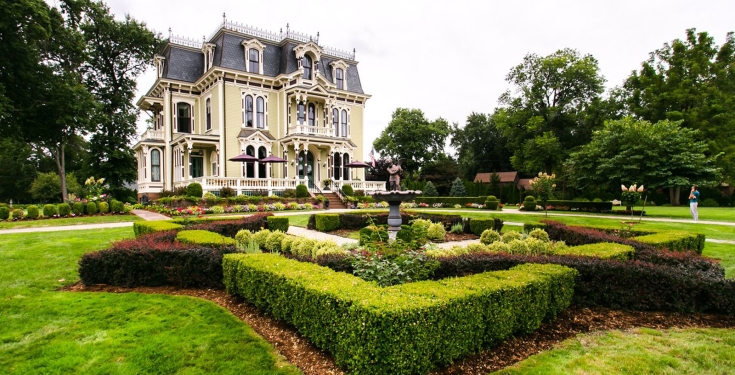
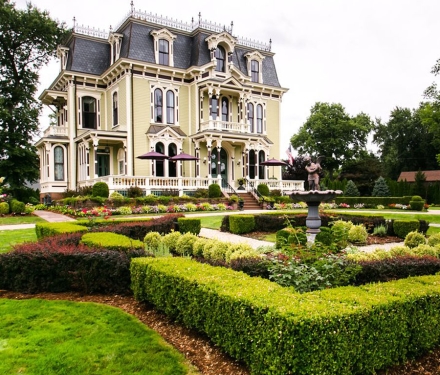
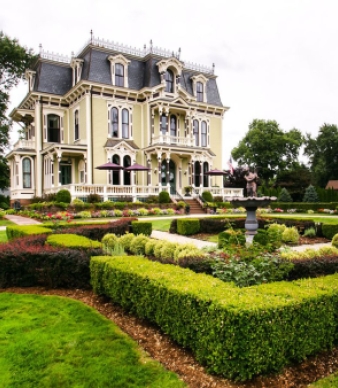
The Victorian Era remains visible everywhere in Connecticut, in its churches, public buildings and cemeteries, but perhaps nowhere as much as in its private houses. Go to the center of any of the state’s 169 cities and towns, and you’ll see them -  sometimes solo, sometimes lined up as if in formation - these great “painted ladies” of a bygone era, a time encapsulated by the 1819-1901 reign of England’s Queen Victoria. The great news is that some of Connecticut’s most spectacular Victorian houses have been saved as museums and are these days open for your inspection, offering not only visual treats but also the story of the house and those who lived there. Here are a few examples, listed by architectural subsets:

Greek Revival. The Smith-Harris House Museum in Niantic is an 1845 farmhouse saved from the wrecker’s ball and brought back to life as a local museum. Especially notable is an extensive front-hall mural depicting the town of East Lyme.

Gothic Revival. Roseland Cottage in Woodstock was built as a summer retreat in 1846 by Henry and Lucy Bowen, he a local native who had made it in New York. The estate, which once hosted presidents and other luminaries, consists of the distinctive rose-colored house as well as elaborate gardens, and ice house, aviary, carriage barn and the nation’s oldest indoor bowling alley.

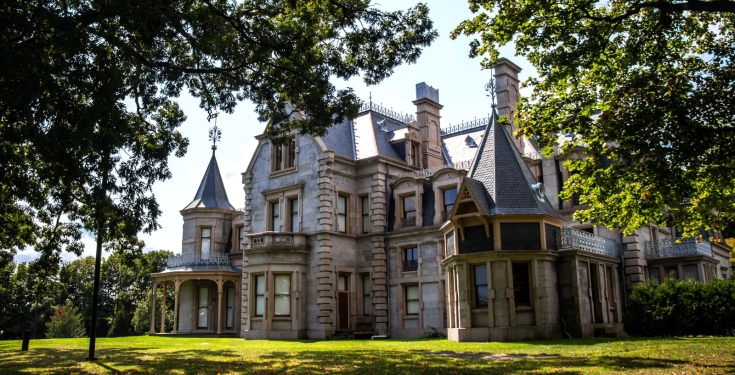
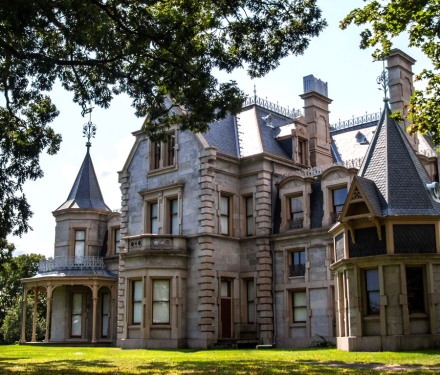
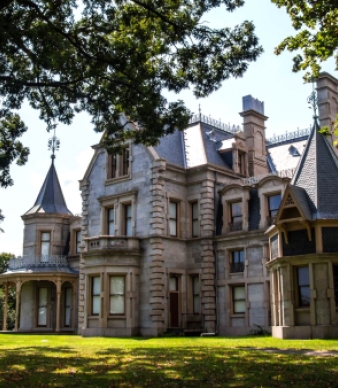
Second Empire Style. Norwalk’s spectacular Lockwood-Mathews Mansion was built 1864-68 by railroad baron and financier LeGrand Lockwood, who suffered financial setbacks during its construction and died not long after it was completed. It was taken over by the Mathews family and eventually passed over to the town, which destroyed many of the outbuildings before finally being persuaded to save the main house.

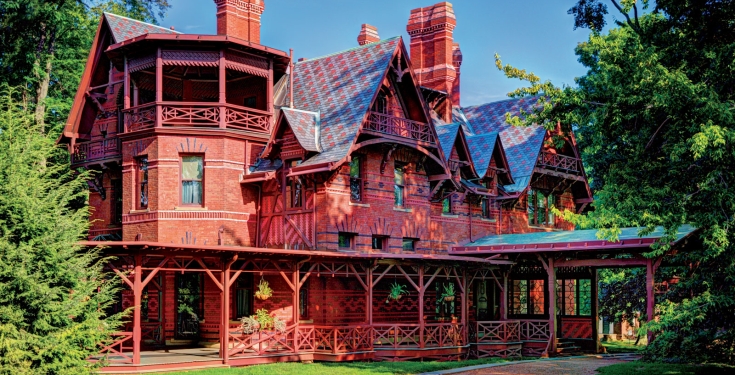
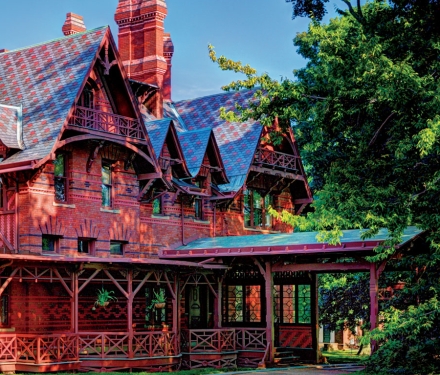
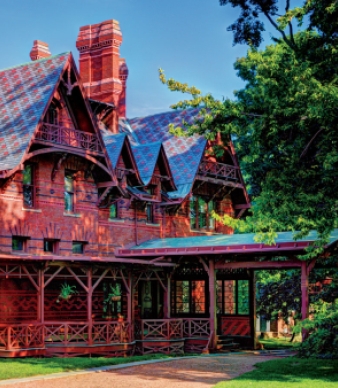
Victorian Gothic. Mark Twain House in Hartford is probably Connecticut’s best known single residence, and today it’s a fitting museum to the greatly beloved American writer. Twain and his family moved into the house in 1874 (“It is a home,” he wrote at the time, “& the word never had so much meaning before.”) and he composed some of his best-known works there.

Queen Anne. The Hotchkiss-Fyler House Museum in Torrington resides in an 1897 gem built by a local business family. It is especially notable today for its magnificent millwork and interior detailing, such as stenciling, murals and ornamental plaster ceilings. The interior remains as it was in 1956, when the last family member moved out.